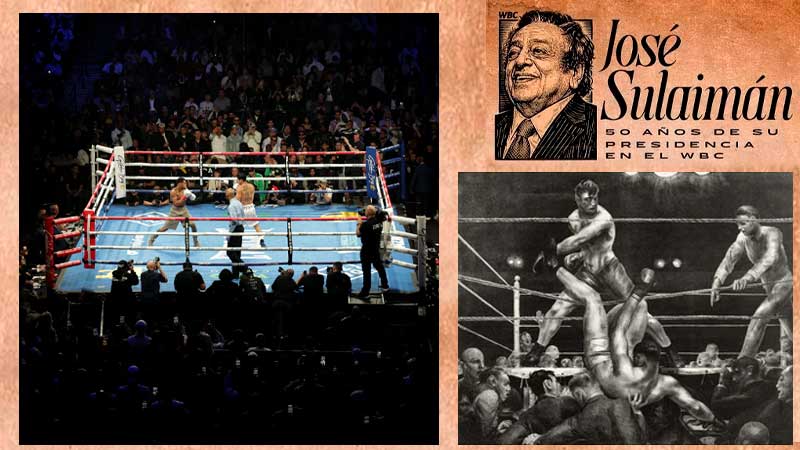

Don Jose Sulaiman Chagnonn—the man who did not just preside over an organization, but truly humanized and modernized the “sweet science”—attained monumental achievements throughout his career.
We continue to honor this throughout 2026.
In the constant evolution of boxing toward becoming a safer sport, one of the most visible and effective structural reforms was the introduction of the fourth rope to the ring.
This measure, promoted with unwavering determination by Don Jose transformed the field of combat from a space of accidental risk into a sanctuary of protection for the athlete.
Prior to this innovation, professional rings featured only three ropes. While it seemed sufficient at the time, practice proved that a dangerous “gap” existed, which unnecessarily jeopardized the physical integrity of the fighters.
Don Jose’s primary objective in establishing the fourth rope was to eradicate accidents caused by falling out of the ring. With only three ropes, the spacing was wide enough that a boxer receiving a power punch near the edge could be propelled backward, slipping under or between the top ropes and falling from the ring platform to the floor or onto the judges’ tables.
Many of the most severe injuries did not occur from the punches themselves, but from the impact of the head hitting the ground or the ring apron upon falling out of the squared circle.
Furthermore, boxers in the lower weight classes, having smaller frames, were even more prone to sliding through the gaps of a three-rope ring.
Although some purists initially felt the fourth rope “enclosed” the spectacle too much, the evidence of its effectiveness was undeniable. The reduction in fall-related injuries was immediate.

test