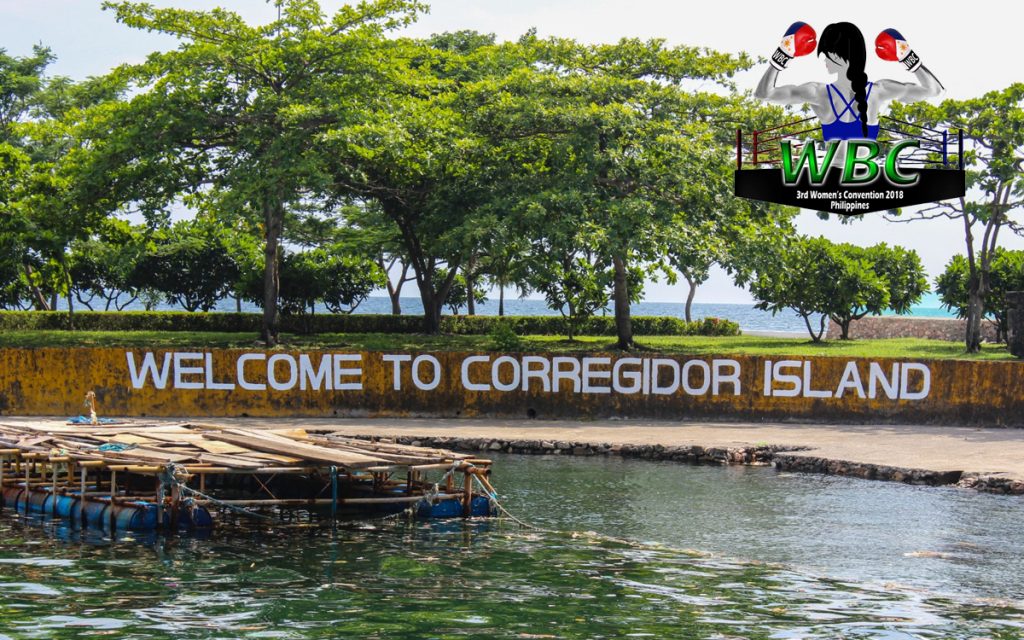

Corregidor Island where time stands still
By James Blears
Many of those who came half a World, to the WBC Asian Summit and WBC third Women’s Convention, decided to take themselves on a tour of Corregidor Island, situated at the mouth of Manila harbor, and reachable by ferry.
It tended to gave us pause for thought about a different and far more deadly form of fighting, called total warfare.
Serenely guarding its tragic legacy, almost eight decades after the heavy guns of the US and Japanese armies finally fell silent, pockmarked shell holes are filled due to tree planting, after the island was declared a war shrine in 1954.
But also thanks to the far more effective yet benign aim of the birds, with seed taking root and growing into a dappled green canopy soaking up the fire, brimstone, blood and ash of the previous carnage. It’s hard to take in that thousands of tons of bombs were dropped on this island. Mother Nature has since applied its special geographically healing balm.
the jungle is slowly but surely frond by frond, leaf by leaf, shoot by shoot, advancing, and closing in on the island. Off the beaten track, leading to an enveloping heart of darkness. Our guide cheerfully says the main inhabitants of the tangle, are monkeys, pythons and Cobras.
On the tour in open sided cable car like vehicles, we come upon a massive ruined military barracks, which pre dates World War Two. In another long ago era, it housed more than four thousand US troops. This now resembles a scene from The Time Machine by HG Wells, with twisted metal and sagging concrete.
Then on to the olive green heavy guns. The big one could fire a shell seventeen miles. You wonder why the huge artillery set piece and its spare barrel still linger there, until you’re informed that they each weigh 52,000 kg!
But the most sobering, somber and chastening part of the tour awaits, as the massive gates of the Malinta Tunnel are opened. Carved out of solid rock from 1922-32, In its time, used as a gigantic bomb shelter, storage area, and the last refuge of two thousand members of the Imperial Japanese Army, who when surrounded, blew themselves to smithereens, with grenades, in a mass suicide, rather then face the ignominy of surrender. An antiquated light and sound show gives us the briefing.
Out of a Japanese Garrison numbering six thousand, of a largely no surrender Army, there were only forty two survivors.
Rusting small arms in the Pacific War Memorial Museum and faded newspaper cuttings, protected behind a sheen of thick glass. I’ve never been on such a silent island, feeling so surrounded by hosts of ghosts.
The famous quote of General Douglas MacArthur, obeying orders to pull out, declaring: “I shall return,” still seems to hang on an incoming sea breeze all the way from Australia, pervading the heavy hot moist, sapping air inland. His statue is aptly near the shoreline while in the nearby hillside there are still some earthy openings to Japanese foxholes.
About two hundred people reside on the island but there’s no permanent settlement allowed. Nature here has taken back control.
The eyes see, the mind tries to comprehend….while the soul grieves.

test